
In physical terms one of the primary aim of yoga postures (asanas) is to increase the space at bony interfaces (joints). The assumption is that the body needs to decompress and lengthen.
In my experience of practicing and teaching yoga, it is often tempting to challenge ourselves and to practice postures at the end range of motion.
However, by doing so we may achieve the exact opposite of the aim of the practice. Instead of lengthening and decompressing the body, we shorten the body and compress the joints.
In yoga backbends, such as upward facing dog, I often see practitioners taking their neck far back in extension, see photo below.
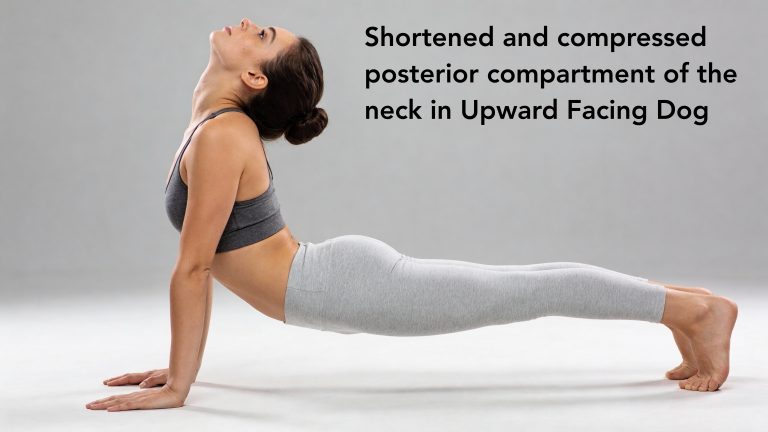
This is something that I avoid. The reason is that hyperextension shortens and compresses the posterior compartment of the neck.
Furthermore hyperextension of the cervical vertebrae tend to compress the vertebral arteries and disrupt blood flow.
This condition is also known as the beauty parlour syndrome after people have had their neck in hyperextension at the hairdresser. See diagram below:
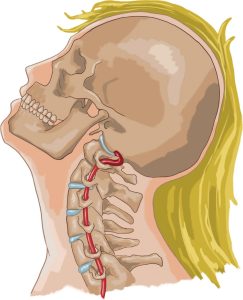
Vertebral artery passing through the foramina of the cervical vertebrae
Therefore instead looking up and of taking my head far back in extension I look forward and aim at finding the alignment that makes my neck long and feel comfortable.
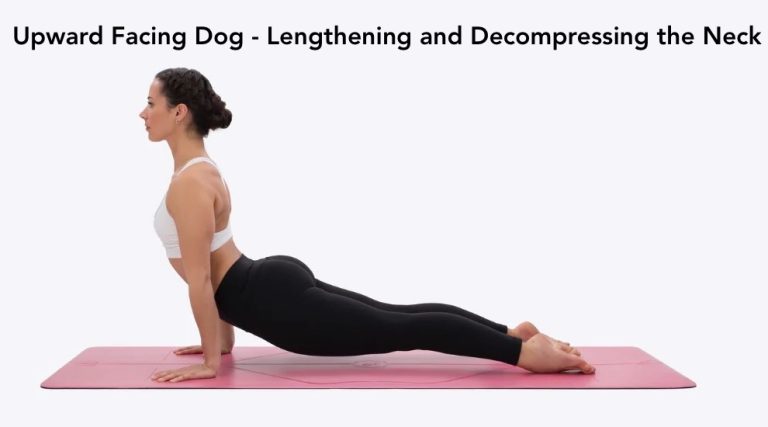
So the next time you practice upward dog and other backbends, try to be mindful of your neck. Instead of practicing at the end range of motion try to aim at lengthening your neck. This principle applies not only to the neck in backbends but also to all body parts and all yoga postures.
You will most likely enjoy your practice even more and in the long run your body will say a big ‘Thank you’.